

What if protecting your Liverpool home didn’t mean lifting floorboards or hiding cables along the skirting? A wireless alarm system Liverpool homeowners can manage from a smartphone may offer a tidier way to improve security. But it’s fair to ask whether wireless technology is dependable and which features are worth paying attention to.
Concerns about burglary, visible wiring and alarm grades can make the decision feel harder than it needs to be. A suitable system should match your property, provide the features you need and fit how you manage security day to day. Wireless alarms are not limited to basic do-it-yourself setups, but the equipment and installation still need careful consideration.
This guide explains what to check in 2026, including how wireless alarms compare with wired systems, what alarm grades mean and how smartphone controls work. You’ll also find practical questions to ask about installation, maintenance and monitoring before choosing a provider in Merseyside. The aim is to help you compare options clearly and understand what a wireless setup involves.
Key Takeaways
- Understand how a wireless alarm system can protect a Liverpool property without extensive cable runs through walls or floors.
- Learn what an alarm grade indicates and what to check when comparing signal and communication options.
- Compare wireless and wired systems by looking at installation disruption, future flexibility and ongoing maintenance.
- Check whether app control, pet-friendly sensors and other features suit your household and property.
- Consider local support when comparing providers. AE Locksmiths offers home alarms and related security services, with no VAT and no call-out fees.
Why Wireless Alarm Systems are the Preferred Choice for Liverpool Homeowners
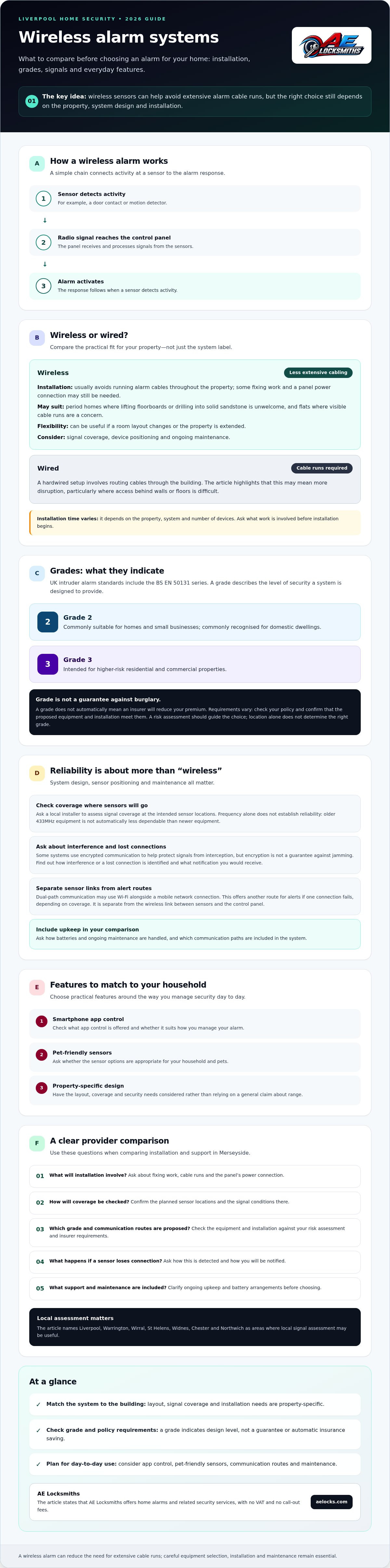
A wireless alarm connects sensors, such as door contacts and motion detectors, to a central control panel using radio signals. The panel receives and processes those signals, then activates the alarm when a sensor detects activity. For a basic overview of alarm components and types, see this guide to a security alarm system.
Because the sensors communicate wirelessly, installation usually avoids running alarm cables throughout the property. That can mean less disruption than a hardwired setup, particularly in a period home where lifting floorboards or drilling into solid sandstone walls may be unwelcome. Some fixing work may still be required, and the panel may need a power connection. Ask what the installation involves before work begins.
The Shift Towards Wireless Security in Merseyside
Wireless sensors can suit modern flats where residents want to avoid visible cable runs, as well as older homes where access behind walls or floors is difficult. They may also offer flexibility if a room’s layout changes or the property is extended. Installation can be quicker than routing cables throughout a building, although the time involved depends on the property, system and number of devices.
Choose an alarm to suit your property’s layout and security needs, rather than making assumptions about a neighbourhood. A local installer can assess signal coverage in the rooms where sensors are planned. This is useful whether you’re in Liverpool, Warrington, Wirral, St Helens, Widnes, Chester or Northwich.
Addressing the Reliability Myth
Wireless reliability depends on system design, correct sensor positioning and ongoing maintenance. Some modern systems use encrypted communication to help protect signals from interception, but encryption is not a guarantee against jamming. Ask how the alarm identifies interference or a lost connection, and what notification you’ll receive if a sensor stops communicating.
Frequency alone does not tell you whether a system is reliable. Older equipment using 433MHz is not automatically less dependable than newer equipment. Performance depends on factors such as device design, signal conditions and installation. Ask for coverage to be checked at the intended sensor locations rather than relying on a general claim about range.
Some systems offer dual-path communication, such as Wi-Fi alongside a mobile network connection. This can provide another route for alerts if one connection fails, but it is separate from the wireless link between sensors and the control panel. Check which communication paths are included and whether the property has suitable coverage. A wireless alarm system Liverpool homeowners consider should be matched to the building, not chosen on the word “wireless” alone.
Understanding Wireless Security Technology: Grades and Signals
A wireless alarm is more than a set of sensors. Its control panel receives signals from devices around the property, manages the alarm and, if communication features are included, sends alerts through the available connection. The grade and signalling method affect how a system is designed, so check these details before deciding what is suitable for your home.
UK intruder alarm standards include the BS EN 50131 series. A grade indicates the level of security a system is designed to provide. It is not a guarantee against burglary, and a particular grade does not automatically mean an insurer will reduce your premium. Ask your insurer what it requires, then confirm that the proposed equipment and installation meet those requirements.
Alarm Grading: Grade 2 vs Grade 3
Grade 2 is commonly suitable for homes and small businesses, whilst Grade 3 is intended for higher-risk residential and commercial properties. A Liverpool City Centre business handling valuable stock or operating in a higher-risk environment may need to consider Grade 3, but location alone does not determine the right grade. A risk assessment and any insurer requirements should guide the decision.
Grade 2 is a commonly recognised security level for domestic dwellings, but insurance requirements vary. Check your policy before choosing a system.
If you’re considering a wireless alarm system for a Liverpool home, ask the installer to explain the proposed grade and how it relates to your property’s risks. Do not assume that a wireless design cannot meet a recognised grade. Both the equipment and installation matter.
Signals, Batteries and Maintenance
Some alarms use dual-path signalling, for example Wi-Fi and a mobile connection such as 4G or 5G. If one route becomes unavailable, the second may offer another way to communicate, depending on coverage and system configuration. This does not guarantee an uninterrupted connection. Ask which paths are included, whether mobile connectivity is supported at your address and how the system reports a lost connection.
Wireless sensors rely on batteries, but battery life varies with the device, usage and conditions. Check the manufacturer’s guidance rather than relying on a general estimate. Ask whether the panel or app warns you when a sensor battery is low, and what to do if a sensor stops checking in. Resolve battery and connection alerts rather than leaving them unattended.
Regular checks can help you spot faults, battery warnings or changes in signal performance. Follow the manufacturer’s maintenance instructions and ask whether professional servicing is appropriate for your system. AE Locksmiths is a family-run Liverpool business offering home alarms. You can review its local home alarm support when comparing options.
Wireless vs Wired Alarms: Which is Best for Your Property?
Neither option suits every building. Wireless alarms connect sensors to the control panel without long cable runs, which can make them easier to adapt if you extend your home or change a room’s layout. Sensors may be repositioned, but they need to be reconfigured and tested correctly after a move.
Wired systems use physical connections between devices. Their components can cost less, but installation may involve more labour, particularly if cables need to run through finished walls or floors. The full cost depends on the building and work involved, so compare itemised quotations rather than equipment prices alone.
Maintenance differs too. Wireless sensors need battery checks and replacements, while wired systems need attention to cable and connection condition. Both types require appropriate testing and upkeep.
Installation Disruption and Hidden Costs
Running cables through a decorated home can mean making holes or lifting floorboards, followed by repairs and redecorating. Those extra tasks can affect the project’s total cost and disruption. Wireless installation can reduce the need for cable routes, though devices still need to be fitted and signal coverage checked.
That flexibility may appeal to renters and businesses in temporary premises, but get the owner’s permission before fitting equipment. Also check whether the system can be removed or relocated later. Planning an alarm upgrade? This guide to intruder alarm installation Liverpool can help you understand why a wireless-first assessment may be a practical starting point.
Suitability for Different Liverpool Property Types
A wireless setup may suit a new-build in Norris Green where residents want to avoid visible cabling and keep options open for future changes. In a large commercial warehouse in Speke, the building’s size and layout matter more than its postcode. Before choosing, ask for an assessment of sensor coverage, signal reliability and the security grade required for the premises.
For some complex properties, a hybrid system combines wired and wireless devices. This may make sense where some areas are easier to cable, while other locations would be difficult or disruptive to reach. It is not automatically the best of both worlds. Check compatibility, maintenance needs and the total cost over time.
Ask an installer to explain the proposed equipment, installation work, ongoing maintenance and any likely redecoration. A wireless alarm system Liverpool property owners choose should fit the building and their plans, not just the initial quotation.
Key Features to Look for in a Modern Wireless Alarm
A smartphone app may let you check system status and arm or disarm the alarm remotely, depending on the setup and your internet connection. Before choosing a system, check who can access the account, how notifications are managed and what happens if your phone or home connection is unavailable.
Sensor choice matters as much as app control. Pet-friendly Passive Infrared (PIR) sensors are designed to reduce unwanted activations caused by pets, but placement and an animal’s size and movement can affect performance. Shock sensors provide another option by detecting impact or vibration at selected doors and windows. Ask how each device works and which entry points it is intended to cover.
Some systems can work alongside CCTV to provide a clearer picture when an alarm is triggered. Compatibility varies, so confirm that the alarm and cameras can share relevant events before choosing equipment. See this guide to CCTV installation Liverpool for more on combining cameras with property security.
Smart Home Integration and Alerts
Depending on the system, push notifications can tell you when the alarm is triggered or when someone arms or disarms it. Some households may use alerts to check activity around the time children arrive home, but notifications are not a substitute for supervision or a monitored response service. Check which events the app records and who can see them.
Integration with smart lighting may let you schedule lights or switch them on remotely while you’re away. For a business, an event log can help review arming, disarming and alarm activity. Ask how long records are retained, where data is stored and whether the features require a subscription.
Peripheral Devices: Beyond the Siren
Some alarm panels support compatible smoke or heat detectors and panic buttons. These are separate functions, and not every system includes or supports them. Confirm which devices are compatible and what happens when they activate. Do not assume an intruder alarm replaces a dedicated fire-safety system or an agreed emergency procedure.
Electronic alerts work best alongside sound physical security. A faulty handle or lock can weaken a door, even if the alarm detects activity. Arrange repairs where needed and read this guide to UPVC door handle repair Liverpool for signs that a door mechanism needs attention.
Choosing a wireless alarm system Liverpool residents can use comfortably means matching features to the household, not buying every available add-on. For more on home alarms alongside CCTV and door security, visit AE Locksmiths’ security services.
Professional Installation in Liverpool: The AE Locksmiths Advantage
Choosing an installer involves more than fitting sensors. A local, family-run business can discuss your property, assess where devices are needed and explain how the setup will work. Direct contact can also be useful if you need help after installation. When comparing providers, ask who will assess the property, configure the alarm and explain its operation.
AE Locksmiths is a Liverpool business offering home alarms and locksmith services. It provides 24-hour emergency locksmith services and states a 20-minute response time. These details relate to its emergency locksmith service, so confirm the arrangements that apply to your situation when requesting support.
Save Money with No VAT and No Call-Out Fees
AE Locksmiths states that it charges no VAT and has no call-out fee. Before agreeing to an installation, request a written quotation that sets out the work and costs. This makes it easier to compare the complete proposal with other quotes.
Understanding the full scope matters more than a headline figure. Ask whether the quotation covers equipment, fitting, setup and any follow-up work, and check for exclusions. No call-out fee and no VAT are clear pricing terms to consider alongside what is included in the installation.
AE Locksmiths also states that parts are covered by a 12-month guarantee. Ask which alarm parts are included and what the guarantee covers, so you know how it applies to your chosen system.
Local Knowledge and Rapid Response
Liverpool properties vary, from older homes with solid walls to newer buildings and commercial premises. An installer should assess the actual property rather than rely on a standard layout. If you’re in Liverpool, Warrington, Wirral, St Helens, Widnes, Chester or Northwich, discuss device placement, signal coverage and how support works once the system is in use. Do not assume that every address or emergency has the same response arrangements.
Businesses may also benefit from considering physical entry points alongside alarms. A joined-up assessment can look at how alarm technology complements commercial door security. Read more about commercial locksmith Liverpool services when planning workplace security.
When comparing a wireless alarm system Liverpool installation, ask AE Locksmiths about the proposed setup, written quotation and support arrangements. The final section explains how to take the next step.
Choose Wireless Security That Fits Your Property
A suitable alarm should match your home, its layout and the level of protection you need. Wireless systems can avoid extensive cable runs, while the right grade, suitable signal paths and useful app features can make the setup practical day to day. Compare these details before deciding which wireless alarm system Liverpool is right for you.
Professional installation can help with sensor positioning and configuring the system for your property. AE Locksmiths is a family-run Liverpool business that charges no VAT, has no call-out fees and provides a 12-month guarantee on parts. The business also states a 20-minute response time for its emergency locksmith service. Check your written quotation for what is included and which guarantee terms apply.
To discuss a home alarm for your property, contact AE Locksmiths about your security options.
Frequently Asked Questions
Are wireless alarm systems as secure as wired ones?
They can be, provided the equipment suits the property and is correctly installed and maintained. Wireless systems communicate between sensors and the control panel by radio, while wired systems use physical connections. Security depends on more than the connection type: consider the system’s grade, signal monitoring, sensor placement and upkeep. Ask the installer to explain how the proposed setup meets your needs and any requirements set by your insurer.
Do wireless alarms work if the Wi-Fi goes down in my Liverpool home?
The alarm may still detect activity and sound locally if Wi-Fi fails, but app access and remote alerts could be affected. What continues to work depends on the system and its configuration. Some alarms have a second communication route, such as a mobile network connection, but coverage and subscription arrangements vary. Before choosing a wireless alarm system, Liverpool homeowners should check which functions remain available during an internet outage.
How often do the batteries need changing in a wireless alarm?
There is no single replacement interval for every wireless alarm. Battery life varies by sensor, battery type, activity and conditions in your home. Follow the manufacturer’s guidance and check whether the control panel or app warns you when a battery is running low. Do not ignore a warning. Replace the battery as instructed, then check that the sensor reconnects and the system shows it is operating normally.
Can I install a wireless alarm system myself or do I need a professional?
Some wireless alarms are designed for do-it-yourself installation, while others need professional fitting or configuration. Consider whether you can position and test every sensor, set up the panel and understand alerts or faults. If your insurer specifies a grade or installation conditions, confirm those requirements before buying. A professional can assess coverage and explain the system, which may be helpful in a property with a difficult layout or thick walls.
Will my pet set off the wireless alarm sensors?
It is possible, but suitable pet-friendly PIR sensors and careful positioning can reduce the risk of false alarms. These sensors cannot guarantee that pets will never trigger the system. Performance depends on the device, its placement and your pet’s size and movement. Tell the installer about your animals and where they can roam, then ask how to test the setup before relying on it.
What happens if a burglar uses a signal jammer on my wireless alarm?
There is no single outcome, as systems respond differently to interference. Some can detect a lost or disrupted sensor signal and show a fault or send an alert, depending on their design and available communication routes. Encryption can help protect communications, but it does not make a system immune to jamming. Ask the installer how your chosen alarm detects interference and what you’ll be told if a connection is lost.
Do wireless alarms save money on home insurance in the UK?
Not automatically. Any effect on your premium or cover depends on your insurer and policy conditions. Some insurers may specify an alarm grade, installation arrangements or other requirements, so check directly before choosing a system. Ask your insurer to confirm its conditions in writing, then make sure the proposed equipment and installation match. Do not assume that fitting any wireless alarm will qualify you for a discount.
Can I add more sensors to my wireless system later on?
Often, but it depends on the alarm’s compatibility, capacity and configuration. Before buying, ask how many additional devices the control panel can support and whether new sensors must match the existing system. A later extension may also need signal coverage checks and testing. If you’re in Liverpool, Warrington, Wirral, St Helens, Widnes, Chester or Northwich, discuss likely layout changes and future additions when planning sensor locations.


