

A strong front door is only one part of a secure home. A residential security assessment in Wirral reviews entry points, locks, windows, boundaries and security systems, then ranks weaknesses by the risks they pose to people and property. The findings give you a clear order for addressing them.
It’s sensible to want more than a list of equipment or a general recommendation to improve security. You need to know how an assessment works, what it covers and why some actions take priority over others.
This guide explains what an assessor examines, from doors and windows to lighting, alarms, CCTV and access control. It also explains how findings can be documented and compared across several homes, helping you see where attention is most needed and plan practical next steps.
Key Takeaways
- Assess doors, windows and access systems alongside CCTV, lighting and alarms to build a clearer picture of how a home is protected.
- Review fences, gates and landscaping for weak spots, including places that could provide cover or help someone climb.
- Compare findings across residences using consistent criteria, then prioritise vulnerabilities by their likely consequences and urgency.
- Use the findings to guide practical improvements, including locksmith work for locks, doors and windows where these are the main concerns.
CCTV, lighting, alarms and access control
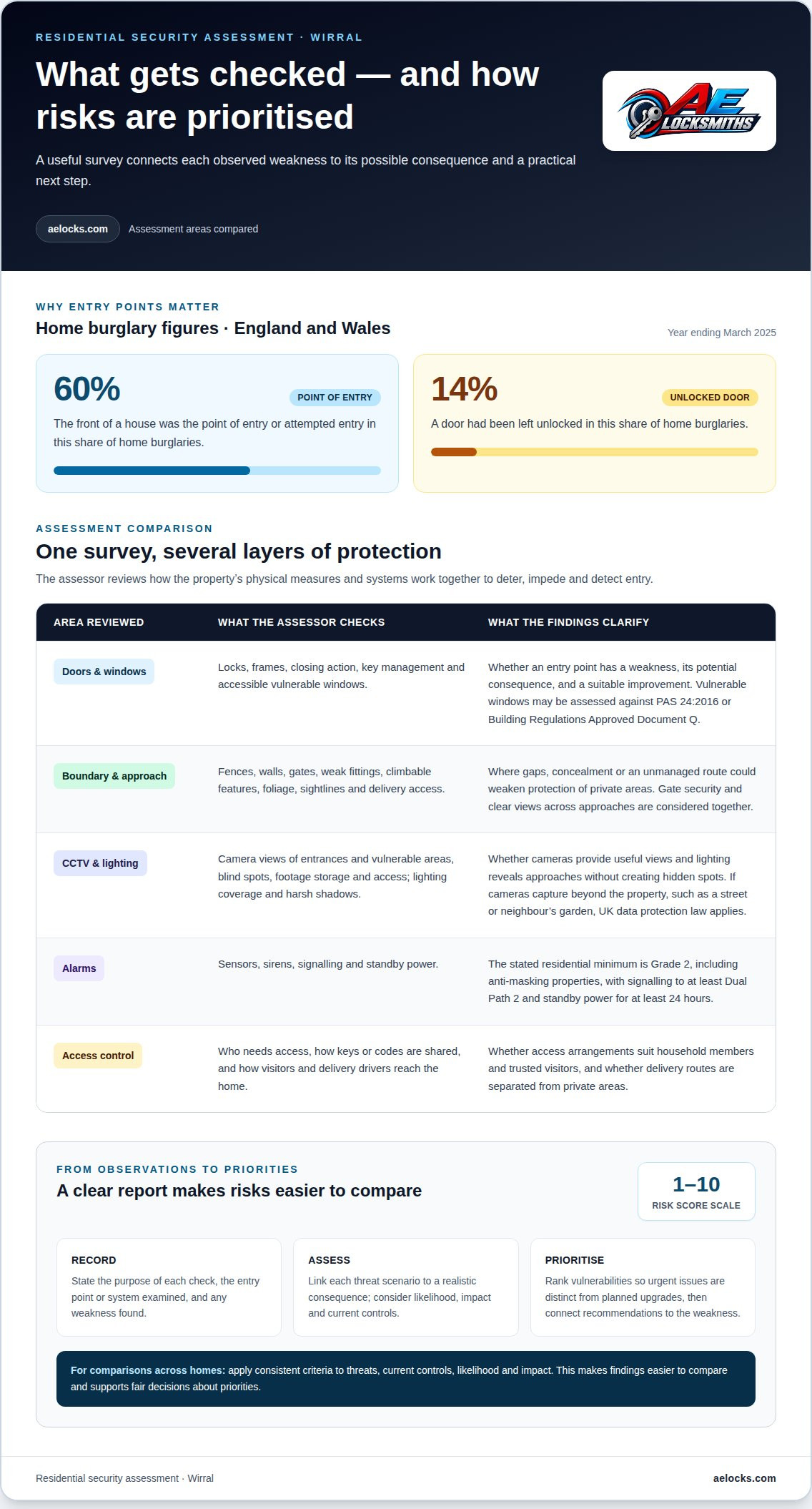
A residential security survey examines how physical measures work together to deter, impede and detect entry. It checks the front and rear approaches, doors, windows, cameras, lighting, alarms and access control. In England and Wales, the front of a house was the point of entry or attempted entry in 60% of home burglaries in the year ending March 2025. A visible camera or light can help deter intruders, but its position and coverage matter.
Assessors review whether CCTV captures useful views of entrances and vulnerable areas, without unnecessary blind spots. They also consider where footage is stored and who can access it. If cameras capture beyond the property, such as a street or a neighbour’s garden, UK data protection law applies. Lighting should reveal approaches without creating harsh shadows that hide people. Alarm checks can cover sensors, sirens, signalling and standby power. The NPCC Security Systems Group’s residential alarm requirements set Grade 2, including anti-masking properties, as the minimum grade, with signalling to at least Dual Path 2 and standby power for at least 24 hours.
Door checks include the lock, frame, closing action and how keys are managed. The assessment can identify where a high-security lock or controlled keyless entry may address a weakness. It also considers who needs access, including household members and trusted visitors, and whether codes or keys are shared too widely. In the year ending March 2025, a door had been left unlocked in 14% of home burglaries in England and Wales.
Local road and public transport access can inform how people approach the property, but employment-site road thresholds are not residential security measures. For example, Wirral employment-site criteria use proximity to an M53 junction and bus stops; those ratings should not be applied to homes. A residential survey instead notes entrances, sightlines and practical access for emergency responders. Findings help show whether barriers, lighting, locks and alarms reinforce one another or leave a gap.
What areas are evaluated in a residential estate security assessment?
A survey reviews a property’s perimeter, lighting and delivery access, then records weaknesses and practical security measures. It considers how these features work together to protect private areas.
Perimeter Barriers, Gates and Fencing
Perimeter barriers include fences, walls and gates that mark and protect a property’s boundary. Their condition and design matter: gaps, weak fittings or features that are easy to climb can create easier routes into private space.
The assessment considers whether gates close securely and whether fencing offers consistent coverage around the boundary. Ornate gates can provide easy-to-reach climbing aids. Overgrown foliage can also conceal someone or create a hidden route. Where trees affect natural surveillance, keeping them trimmed can help maintain clear sightlines.
Security Lighting and Delivery Barriers
Security lighting helps reveal approaches and boundary areas after dark, while delivery barriers control how visitors reach the home. A poorly lit entrance or unmanaged delivery route can weaken otherwise sound perimeter security.
The survey checks whether lighting covers entrances without creating harsh shadows or hidden spots. It also considers where delivery drivers stop, how they reach the door and whether gates or other barriers separate the delivery point from private areas. Delivery schedules can inform when access is needed, but the assessment focuses on the property’s layout and arrangements rather than assuming a standard schedule.
There is no single UK-wide qualification or accreditation requirement for every residential assessment. Ask what relevant training and experience supports the work, and what the written findings will cover. A useful assessment should explain its scope, observations and recommended priorities clearly.
There is no universal free-assessment offer in Wirral; whether a visit is free depends on the provider and the work involved. A residential assessment can cover perimeter barriers, gates, fencing, landscaping, lighting and access routes. Local locksmith and security firms may offer assessments, but this section does not establish which specific firms do. To arrange one, provide the property location and outline the areas you want assessed. For help with property security, contact AE Locksmiths. Clear written findings and an explained scope help you assess the service’s credibility.
Security assessment reporting and risk prioritisation
A useful report turns observations into clear recommendations, explaining each risk, its likely consequence and the next step. Consistent criteria make findings easier to compare across properties.
Detailed Written Reports
A detailed written report records the purpose of each check, the entry point or system examined, and any weakness found. This gives householders a practical basis for decisions instead of a list of equipment without context.
For example, a report might describe an accessible window, explain how it could affect entry, then recommend a suitable improvement. Accessible vulnerable windows may be assessed against PAS 24:2016 or Building Regulations Approved Document Q. Recommendations should connect the identified weakness to a practical measure, with enough detail to understand what needs attention.
Risk-Ranked Findings
Risk-ranked findings order vulnerabilities by their potential likelihood and impact, so urgent issues are easier to distinguish from planned upgrades. An estate security risk score can use a scale from 1 to 10 to record threats, current controls, likelihood and impact.
Each threat scenario should be linked to a realistic consequence before changes are recommended. For example, a weak entry point may put residents or property at risk, while a faulty camera may limit detection. Applying the same criteria across homes makes results easier to compare and supports fair decisions about priorities.
Prioritisation should also consider what could happen if a weakness remains unresolved for another 30 days. That timeframe helps decision-makers discuss urgency in concrete terms, without treating every finding as equally immediate. The report can separate actions that need prompt attention from measures suited to a planned programme.
Recommendations are most useful when they state the issue, its consequence, the proposed response and its purpose. For several homes, a shared format can reveal recurring problems, such as similar door weaknesses, while retaining details specific to each property. This supports a clear response: address the highest risks first, record decisions and keep lower-priority improvements visible for later review.
Security assessments across multiple residences
Assessing several homes together reveals shared weaknesses without treating every property as identical. In Wirral, burglary and other crime risks can vary with a home’s layout, access routes, visibility and surrounding activity. Local patterns help ground recommendations, but each residence still needs its own assessment.
Consistent records make differences easier to understand. For each address, document entry points, fences, lighting, locks and existing security measures. The report can then distinguish a shared issue, such as similar boundary weaknesses, from a property-specific concern, such as a concealed side entrance. This evidence helps decision-makers compare like with like and set priorities.
Protecting residents comes first; possessions are a secondary concern. A household profile can show who lives at each property, who regularly needs access and what arrangements matter in an emergency. For example, a home occupied by someone with limited mobility may need a different response plan from an unoccupied property. Recommendations should reflect practical needs, not just equipment.
Neighbourhood risks are not uniform. A residential security assessment in Wirral can consider local crime patterns and police liaison alongside a property’s physical features. This helps distinguish a general concern, such as burglary, from a specific exposure, such as poor visibility around a rear entrance. Findings should describe the threat, likely consequence and relevant evidence, rather than label an entire neighbourhood unsafe.
For an estate or portfolio, compare findings using the same criteria, then rank actions by risk and consequence. Record who will decide on each recommendation and whether it applies to one address or several. Conduct a full vulnerability audit and system-warranty review annually. Physical testing in a private home should take place only with the owner’s written authorisation, as KSS advises.
Use the assessment findings to plan practical improvements across your properties. Arrange a residential security assessment to discuss the risks and priorities for your homes.
Burglary and other crime risks vary with a home’s layout, access routes, visibility and surrounding activity. Local patterns may point to a general burglary concern, while a specific exposure could be poor visibility around a rear entrance.
AE Locksmiths: Residential Locksmith
AE Locksmiths can help when assessment findings point to a practical issue with locks, doors or windows. Its residential locksmith service addresses lock-related concerns, while its UPVC Windows & Doors service is relevant when the assessment identifies a weakness with those fittings.
Use the report to identify the specific problem and the property affected. This gives you a clear starting point for discussing a suitable repair or security improvement. If the findings concern access to a safe, AE Locksmiths also provides Safe Access.
For several residences, keep each property’s recommendations distinct so work can be discussed against its own findings. Contact AE Locksmiths to discuss your residential locksmith needs.
Turn your findings into a practical plan
A residential security assessment in Wirral is most useful when its findings lead to clear decisions. Treat the report as a working plan: identify which recommendations fit your household, agree what should happen first and keep a record of completed improvements. For several homes, a shared action plan can help coordinate work while preserving each property’s individual priorities.
AE Locksmiths provides residential and commercial locksmith services, along with UPVC Windows & Doors. These are relevant when agreed actions involve locks, doors or windows. Discuss the specific finding you want to address so the repair or improvement responds to the assessment.
Start with the issue that matters most to your property, then move forward one decision at a time. Contact AE Locksmiths about your security to discuss the next step.
Frequently Asked Questions
How Does A Typical Security Assessment Proceed?
A typical assessment starts by agreeing which residence and security concerns are in scope. The assessor then examines the property, noting how household routines, access arrangements and physical features affect security. For example, a side entrance used daily may need different attention from a rarely used outbuilding. Findings are recorded and turned into recommendations, giving residents a practical basis for deciding what to address first.
How often should you perform a physical security audit?
Conduct a full vulnerability audit and review system warranties annually. An earlier review also makes sense after a burglary attempt, a renovation that changes access, or a change in who holds keys or entry credentials. For example, when a tenant moves out, reassess the affected access arrangements. The timing should reflect changes to the property and its use, not just the age of installed equipment.
What is Reviewed In A Physical Security Assessment?
A physical security assessment reviews a property’s layout, entry routes, barriers, locks, windows and installed security systems. It can also examine emergency response plans, evacuation procedures and communication arrangements. For example, an assessment may identify that household members have no agreed way to alert one another if an alarm sounds. The review connects physical weaknesses with how residents use the home and respond to incidents.
What should a home security assessment check, including doors, windows and alarms?
The assessment should examine whether doors close and lock properly, whether window security suits each location, and whether alarms respond as intended. The assessor can note practical issues such as a sticking door, a ground-floor window hidden by planting or an alarm sensor obstructed by furniture. These observations help distinguish a hardware weakness from an everyday-use problem that could leave an otherwise secure entrance vulnerable.
What home security upgrades are recommended after an assessment?
Recommendations depend on the weaknesses found and may include stronger locks, improved window security, lighting, motion sensors, CCTV or an alarm upgrade. For instance, a property with a vulnerable side entrance may need attention there before cameras are added elsewhere. The report should explain how each measure responds to a specific risk. Residents can then plan suitable improvements by priority instead of upgrading equipment without a clear purpose.
What crime and burglary risks vary across Wirral neighbourhoods?
Risks vary with a home’s layout, access routes, visibility and surrounding activity. Local crime patterns and police liaison can help identify threats, but each residence needs its own assessment.


