

Could a stiff shop front lock be warning you about a bigger door problem? If your key sticks, the lock won’t turn or the entrance won’t close properly, it’s understandable to worry about leaving stock and premises exposed. The lock itself may not be the cause: a misaligned door or worn component can also stop it working properly. Shop front door lock repair Liverpool businesses need starts with finding the fault, not assuming every problem calls for a new lock.
This guide explains the signs to look for, when repair may be suitable and what to expect when arranging local help. You’ll learn how a locksmith can assess the lock and door together, identify what needs attention and help restore a reliable way to secure and open your entrance. AE Locksmiths provides commercial locksmith services in Liverpool and across Merseyside, including Warrington, the Wirral, St Helens, Widnes, Chester and Northwich.
Key Takeaways
- Look for signs such as a sticking key, a door that won’t latch or a lock that won’t turn. Don’t force or dismantle anything.
- A fault may involve the door’s alignment or another component, not just the lock. An inspection helps identify what needs attention.
- Learn which symptoms may point towards repair and when the lock may need a replacement assessment.
- When arranging shop front door lock repair, share the location, access conditions and whether the entrance currently secures.
- AE Locksmiths is a family-run Liverpool business with a guaranteed 20-minute response time, no call-out fees, no VAT and a 12-month guarantee on parts.
Shop front door lock repair in Liverpool: recognise the problem
A shop entrance that won’t lock, unlock or close reliably can disrupt opening and closing routines, delay trading and leave stock or premises less secure. A door that looks shut may not be properly latched, so don’t assume it’s secure by appearance alone. Notice what happens each time you use it. Those details can help distinguish a lock fault from a door or hardware problem.
For shop front door lock repair in Liverpool, start by recognising the change and avoid making it worse. A stiff key, loose handle or door that catches can each have different causes. The symptom is useful information, but it isn’t a diagnosis.
Signs your Liverpool shop front lock needs attention
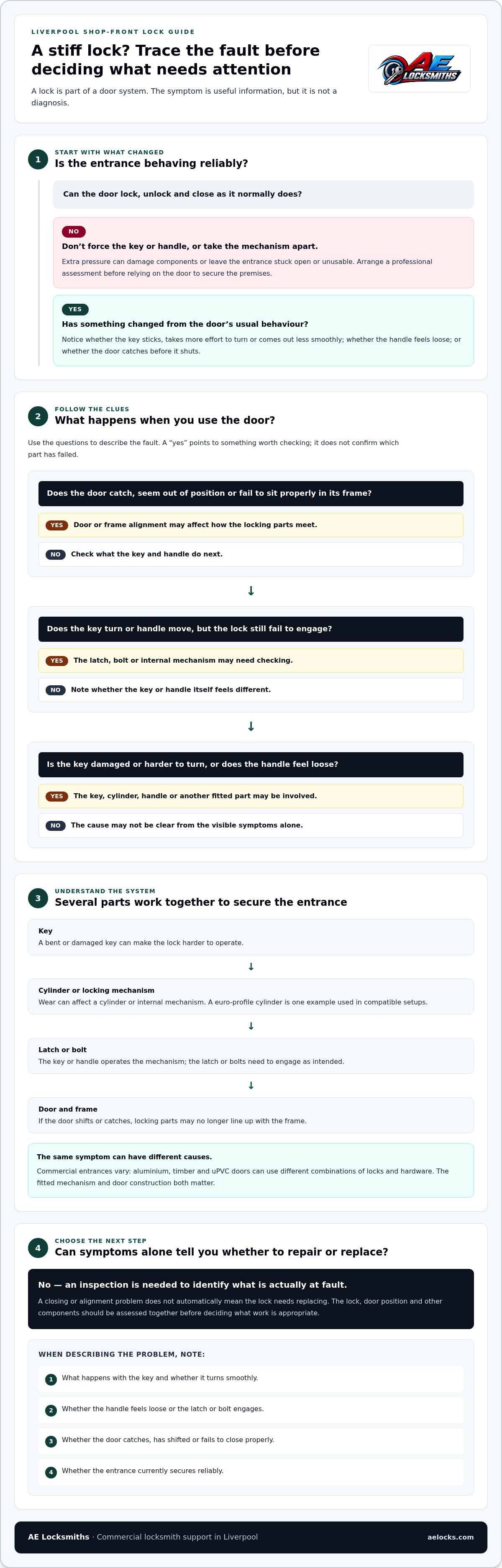
Pay attention to changes from the door’s usual behaviour. A key that suddenly sticks, takes more effort to turn or won’t come out smoothly deserves attention. So does a lock that no longer engages, a handle that moves without operating the latch, or an entrance that won’t stay shut when secured.
- The key turns, but the lock doesn’t engage as it normally does.
- The door closes, but the locking mechanism won’t secure it.
- The handle feels loose, or the door catches before it shuts.
- A familiar action, such as turning the key, has become noticeably harder.
An occasional change may happen because the door isn’t sitting in quite the same position. A symptom that is new, recurring or getting worse is more concerning, especially if staff can’t lock up consistently. Don’t force the key or handle. Extra pressure can damage components or leave the entrance stuck open or unusable.
If a shop door won’t lock, unlock or close reliably, arrange a professional assessment before forcing it or relying on it to secure the premises.
Is the fault in the lock or the door?
A lock works as part of the entrance, rather than always as an isolated component. If the door has dropped, shifted or begun catching against its frame, the locking parts may no longer line up properly. The key can then feel stiff or the lock may fail to engage, even if the lock itself isn’t the only issue. Symptoms alone won’t show exactly what is happening inside the mechanism.
Commercial entrances can also use hardware that differs from the locks on a typical home door. The handle, latch, locking points and other fitted parts can all affect how the entrance closes and secures. A locksmith can assess how the components work together; the locksmith profession covers work on locks and related security hardware.
A closing or alignment problem doesn’t automatically mean the lock needs replacing. An assessment should identify whether the fault lies in the lock, the door’s position or another component, then determine what work is appropriate. Avoid taking the mechanism apart. Instead, note whether the door catches, the handle feels loose or the key’s behaviour has changed, and share those observations when arranging help.
How shop front door locks work and what can fail
A shop front lock is part of a door system. The key, cylinder or handle operates a mechanism inside the door, while the latch or bolts need to meet the frame correctly for the entrance to secure. A problem at any point in that chain can affect locking. A key that turns without securing the door, for example, may point to a different issue from a loose handle or a door that has shifted.
Commercial entrances aren’t all built the same way. Aluminium shop doors, timber doors and uPVC doors can use different combinations of locks and hardware. The right repair depends on both the lock type and the door construction, because the same symptom can have different causes.
Common commercial lock components, explained simply
A euro-profile cylinder is the key-operated part in compatible lock setups. Turning the key operates the locking mechanism; the cylinder itself isn’t necessarily the part that moves the door’s latch or bolts. Some commercial aluminium door systems use a deadlatch, which holds the door closed, or a hookbolt, which hooks into the frame to secure it.
These are examples, not a description of every shop entrance. The fitted mechanism depends on the particular door and hardware. A locksmith needs to identify how the components work together before deciding what needs attention.
Why a shop front door may stop locking properly
Wear can affect a cylinder or internal mechanism over time. A damaged key may also make the lock harder to operate. If the key turns but the latch or bolt doesn’t engage, the fault may be within the mechanism. If the door has moved out of position, the locking parts may no longer meet the frame correctly. These are possible causes, not a diagnosis based on symptoms alone.
- Key or cylinder: the key is bent or damaged, or it no longer turns smoothly.
- Latch or bolt: the key or handle moves, but the locking part doesn’t engage as expected.
- Door or frame: the door’s position may affect how the latch or bolt lines up.
These clues help describe the fault, but they don’t prove which component has failed. Avoid dismantling the lock to investigate. If the mechanism is visibly damaged or jammed, stop trying to force it. Added pressure can worsen the damage or leave the entrance unusable.
For shop front door lock repair in Liverpool, a clear account of what happens with the key, handle and door helps focus the assessment. AE Locksmiths provides commercial locksmith support for shop entrance lock faults, with the work guided by the actual door and mechanism.
Repair or replace a shop front door lock in Liverpool?
A lock fault doesn’t automatically mean the whole shop front door needs replacing. A targeted repair may address the problem in some cases; in others, a worn or damaged mechanism may no longer secure the entrance reliably. The right decision depends on the condition of the lock, door and related hardware, not just the symptom you’ve noticed. This guide to shop front door lock repair is a starting point, but an inspection is needed to identify the fault and recommend suitable work.
| What you notice | What it may suggest | Next step |
|---|---|---|
| A lock has become stiff or a part feels loose, while the door and surrounding hardware appear serviceable. | A limited fault may be suitable for repair, depending on the mechanism’s condition. | Have the lock assessed before deciding whether repair is appropriate. |
| The lock no longer engages reliably, or a component appears damaged or badly worn. | The affected part may need replacement if it can’t secure the entrance dependably. | Have the lock and the way it works with the door inspected. |
| The door or frame is visibly damaged, or the door’s movement affects how it closes. | The cause may extend beyond the lock itself. | Have the wider entrance checked so the recommendation addresses the actual fault. |
When a targeted lock repair may be suitable
A targeted repair may be suitable where the fault is limited and the door, frame and surrounding hardware remain serviceable. For example, the issue could be confined to a component that no longer moves as it should, rather than damage across the whole entrance. The locksmith assesses the mechanism and its operation before recommending work. A symptom alone can’t confirm that repair is possible, so the lock needs to be examined first.
When replacement or wider door attention may be needed
If a component is damaged or worn to the point that it can’t reliably secure the entrance, replacement may be considered. Wider attention may also be appropriate if damage to the door or frame affects how the lock operates. That doesn’t mean the whole door must be replaced. The recommendation should reflect the observed condition of the lock and entrance, rather than follow a blanket rule to repair or replace.
When arranging an assessment, explain what the lock does and when the problem occurs. A clear description helps focus attention on the relevant parts, but the inspection determines the work. The aim is a reliable way to secure the shop entrance, with repairs or replacement limited to what the fault and condition call for.
Before arranging a Liverpool shop front lock repair
A few clear details can help a locksmith understand the problem and plan an assessment. First, consider whether the entrance currently locks and whether staff can use it safely. Don’t force a stiff key, dismantle the mechanism or leave the premises unsecured. If the door won’t secure, follow your business’s site security procedures while arranging help. AE Locksmiths provides commercial locksmith services in Liverpool.
Steps to take before requesting a repair
- Make the situation safe. Keep staff and customers away from a visibly damaged or jammed mechanism. Don’t force the key or handle; repeated pressure can worsen the fault.
- Check whether the entrance secures. Note whether it locks and unlocks, closes fully or remains unreliable. Don’t assume a closed door is secure if the lock hasn’t engaged.
- Record what you observe. Describe the symptom in plain terms, such as “the key turns but the door won’t lock” or “the door catches before it closes”. Note any visible damage or recent incident, without taking the lock apart.
- Share useful details when requesting help. Give the business location, explain access conditions and say whether the entrance currently secures. Mention when the fault happens and whether it affects locking, unlocking, closing or key movement.
Details to have ready when requesting a repair
If you know the door material, such as aluminium, timber or uPVC, include it in your description. You don’t need to identify the lock mechanism. A clear account of what the key and handle do is more useful than a guessed technical name. Explain whether the fault is constant or intermittent, and report visible damage or a recent incident that may have affected the entrance.
These details help frame the request, but they don’t establish the cause. The fault could involve the lock, the door or another part of the entrance, so an inspection is needed to decide what work is suitable. Sharing access arrangements also helps avoid confusion, particularly if the entrance is difficult to reach or staff need to meet the locksmith.
Keep the premises secure while the fault is unresolved
Where practical, limit use of an entrance that operates unreliably and follow your own site security procedures. Don’t rely on a lock that hasn’t engaged, and avoid forcing a damaged mechanism to close. If the problem becomes an urgent lockout, 24-hour emergency locksmith support in Liverpool is available for emergency lockouts.
For shop front door lock repair, businesses in Liverpool, Warrington, the Wirral, St Helens, Widnes, Chester and Northwich can contact AE Locksmiths to discuss the fault and arrange commercial locksmith help. Sharing the location, access conditions and whether the door currently secures gives the request a practical starting point.
Arrange shop front door lock repair with AE Locksmiths in Liverpool
A faulty shop entrance needs a practical response and a clear assessment. AE Locksmiths is a family-run Liverpool locksmith serving commercial customers. For business owners arranging shop front door lock repair in Liverpool and across the surrounding area, the aim is to establish what has failed and what work is appropriate for the door, rather than assume every fault needs the same solution.
AE Locksmiths guarantees a 20-minute response time, charges no call-out fees or VAT, and provides a 12-month guarantee on parts. The response-time commitment relates to the response, not a promise that every repair will take 20 minutes. The time needed to complete work depends on the fault and what the inspection finds.
What to expect from AE Locksmiths
When arranging commercial locksmith help, describe the symptoms and whether the shop entrance currently secures. The locksmith assesses the reported lock fault alongside the door’s operation, looking at how the mechanism works with the entrance. An on-site assessment matters because a key that won’t turn, a lock that won’t engage and a door that won’t close properly can point to different issues.
The recommended work should reflect the condition found at the property. If a repair is suitable, the work can focus on the affected component. If wear or damage means the lock can’t secure the entrance reliably, replacement may be considered. The appropriate option depends on the actual fault, so no repair outcome should be assumed before inspection.
When arranging work, AE Locksmiths’ service terms are straightforward: there are no call-out fees, no VAT, and parts are covered by a 12-month guarantee. The time needed for the job still depends on what the locksmith finds and the work required.
Get help with a shop front lock in Liverpool
Whether the issue needs urgent attention or you’re arranging a planned repair, have the business location, access arrangements and lock symptoms ready. If your entrance also uses fobs or cards, explain how that access system interacts with the door. AE Locksmiths provides fob and card entry services as well as commercial locksmith support.
A clear description helps start the conversation. Contact AE Locksmiths for shop front door lock repair to discuss commercial locksmith help for your premises in Liverpool or the surrounding area.
Keep your shop entrance ready for business
A lock problem is easier to manage when it becomes a clear maintenance decision rather than a last-minute uncertainty at opening or closing. Once the entrance is working again, notice changes in how it operates and raise recurring issues early. Just as business owners rely on services like iRepairMan London to keep commercial mobile devices running, tackling a developing door fault promptly helps minimise disruption to trading or difficulty securing the premises.
For planned work, consider how the entrance is used throughout the trading day and who can coordinate access for an assessment. Let staff know if the door needs careful handling while the fault is unresolved. These steps can help keep day-to-day routines organised while the repair is arranged.
If the door is unreliable now, take the next step rather than leaving the problem uncertain. AE Locksmiths can help Liverpool business owners with urgent or scheduled commercial locksmith work, as well as customers in Warrington, the Wirral, St Helens, Widnes, Chester and Northwich.
Contact AE Locksmiths for shop front door lock repair and discuss a practical next step for your business entrance.
Frequently Asked Questions
Can a locksmith repair a shop front lock after an attempted break-in?
Yes. A locksmith can assess a shop front lock after an attempted break-in and identify damage affecting the lock or its operation. The impact may extend to the door or frame, so the lock may not be the only issue. Tell the locksmith what happened and what you’ve noticed since. If the entrance won’t secure, follow your site security procedures while arranging help.
Is a shop front lock different from a lock on a house door?
It can be. Shop entrances may use different door materials, locking hardware or access arrangements from those in a typical home. A business entrance may also need to work with staff access routines, such as several authorised users entering throughout the day. The fitted system varies, so sharing the door type and how it’s used helps explain the setup.
Can I keep using a shop door if the key is stiff?
Don’t keep using it as normal if the key is becoming harder to turn. Resistance may increase, and forcing the key could damage it or leave it stuck. If it still operates without force, avoid unnecessary use and arrange an assessment rather than waiting for the lock to fail during opening or closing. Tell staff not to apply extra pressure, and note when the stiffness occurs.
What should I do if my shop front door will not lock after closing?
Don’t assume the premises are secure if the lock hasn’t engaged. Follow your business’s site security procedures, keep staff informed and arrange locksmith help promptly. If another authorised entrance is available, use it in line with your procedures rather than forcing the faulty door. Explain that the shop is closed and the entrance won’t lock so the immediate security concern is clear.
Can a locksmith repair a shop front door lock outside normal trading hours?
AE Locksmiths provides 24-hour emergency lockout support for commercial customers. This service is for emergency lockouts and doesn’t mean every repair appointment takes place outside normal trading hours. If a lock fault happens after the shop closes, explain whether anyone is locked out, whether the entrance secures and what access is possible. This helps distinguish an emergency lockout from a repair request.
Does a shop front lock repair include a key fob access system?
A mechanical lock fault and a fob or card access fault can involve different parts of the entrance. AE Locksmiths provides fob and card entry services as well as commercial locksmith work. If staff can open the door with a key but their fobs won’t grant access, mention that distinction when describing the problem. If both the key and access system are affected, explain what each one does.
Is there a call-out fee for shop front lock repair from AE Locksmiths?
AE Locksmiths charges no call-out fees or VAT. When you describe the fault, clarify that you need a shop front lock repair and explain whether the entrance currently secures. That gives the conversation a clear starting point and helps distinguish a repair request from an emergency lockout or a wider access-system issue.


