

What if a property looks empty, but the tenancy hasn’t legally ended? That distinction is central to landlord changing locks between tenants UK law. A tenant moving out or handing back some keys doesn’t always mean the landlord can immediately exclude them. If the tenancy is still in force, changing the locks could interfere with the tenant’s right to occupy and may amount to unlawful eviction.
It’s understandable to want to secure a property before a new tenant moves in, especially when you don’t know who may still have a copy of the keys. First confirm that the previous tenant’s right to occupy has ended. Don’t rely on appearances or an assumed move-out date. Rules also vary across England, Wales, Scotland and Northern Ireland. In England, the Renters’ Rights Act 2025 took effect on 1 May 2026, replacing new fixed-term tenancies with rolling periodic tenancies.
This guide explains how to distinguish a genuine gap between tenancies from an ongoing tenancy, what legal and practical details to check before changing locks, and how to organise a secure handover for the next tenant.
Key Takeaways
- For landlord changing locks between tenants UK law, the key question is whether the previous tenant’s right to occupy has ended and possession has returned.
- Rules differ across England, Wales, Scotland and Northern Ireland, so identify which nation’s housing law applies to the property.
- Use the tenancy and handover details to distinguish a completed move-out from a tenant who may still be entitled to access.
- Before arranging a lock change, verify the tenancy status, record the handover, account for keys and plan the work.
- Once possession is clear, organise the lock change and keep an up-to-date record of keys issued to authorised occupants.
Landlord changing locks between tenants: what does UK law allow?
A landlord may usually arrange a lock change once the previous tenancy has legally ended and possession of the property has returned. An empty-looking home isn’t enough to establish that. Whether you can change the locks depends on the tenancy’s status and the law that applies where the property is located. This section concerns locks changed between occupants, not a tenant changing locks while still living in the property.
A clear, agreed handover is different from a tenant who is temporarily absent, can’t be reached or has left belongings behind. Written confirmation that the tenancy has ended, along with a clear return of possession, can help document a completed handover. If the tenant is absent or the situation is disputed, those signs may not settle whether they still have a right to occupy. Don’t treat silence or an apparent move-out as automatic permission to exclude them.
Before taking steps that prevent access, establish that the former tenant’s right to occupy has ended. The precise process and terminology depend on the property’s jurisdiction, so check the rules that apply rather than treating this as a universal procedure for every UK tenancy.
An empty property is not automatically a vacant tenancy
Three concepts can matter: surrender, where a tenancy is brought to an end by agreement; expiry, where a tenancy ends under applicable terms and law; and possession, meaning the landlord has regained the right to control and occupy the property. Their legal effect can vary across England, Wales, Scotland and Northern Ireland. A returned key or belongings left behind may be relevant evidence, but neither is conclusive on its own.
For example, a tenant may have gone away but still intend to return, or may dispute that the tenancy has ended. If there’s uncertainty, don’t change the locks in a way that prevents access. Establish the tenancy position first and seek appropriate legal guidance if the facts are contested.
Is a landlord legally required to change locks between tenants?
There is no general requirement identified here for every landlord to change locks at every change of tenant. Specific legal or contractual requirements may apply to a particular property or tenancy, so check those before relying on a broad statement. The Landlord and Tenant Act 1985 is relevant to certain landlord responsibilities in England and Wales, but it shouldn’t be treated as a blanket rule requiring a lock change between tenancies.
Legal duty and sensible security are separate questions. A lock change after possession is clear can help manage the risk of old keys still working, but it remains a practical decision unless a specific legal or contractual requirement applies. Review any relevant insurance terms for security conditions too. First confirm the handover is complete and identify which jurisdiction’s rules apply.
Which UK rules apply to landlords changing rental-property locks?
There isn’t one tenancy rulebook covering every rental property in the UK. England, Wales, Scotland and Northern Ireland each have their own legal framework, and the rules can depend on the tenancy type and circumstances. Check the law for the property’s jurisdiction before arranging a lock change. This matters for landlord changing locks between tenants UK law, because a statutory reference or procedure that applies in one nation may not apply in another.
In England, the Renters’ Rights Act 2025 took effect on 1 May 2026 and changed the tenancy system. The GOV.UK Private Renting Guidance explains rights and responsibilities for private renting in England. It isn’t a guide to the rules in Wales, Scotland or Northern Ireland. For a property elsewhere in the UK, use current guidance from the relevant national government or seek advice from a qualified housing professional.
Why the property’s UK jurisdiction matters
The property’s location determines which housing laws and procedures are relevant. Legislation may also have a limited scope. For example, the Landlord and Tenant Act 1985 covers certain landlord responsibilities in England and Wales, including repair duties. That doesn’t make it a general rule requiring landlords to change locks between tenancies, or make its provisions applicable across the whole UK.
Before relying on a legal statement, verify the legislation’s current wording, amendments and territorial scope. Check any notice or possession requirements against up-to-date official guidance for the property’s nation. If possession is disputed, don’t rely on a general online summary to decide whether access can be restricted. The lock-change question is separate from the legal steps needed to resolve a dispute.
Tenancy terms, access, and possession are different questions
A tenancy agreement may set out responsibilities for keys, access or security, but a clause doesn’t automatically settle every question about possession or a tenant’s right to enter. Read the agreement alongside the facts: Is the tenancy still in force? Has it ended under the applicable rules? Has possession returned? The answers may depend on the jurisdiction and circumstances.
Keeping a spare key doesn’t give a landlord unrestricted access while a tenant is entitled to occupy the property. Access rights and possession rights are separate from the practical need to maintain secure locks. Responsibilities relating to property condition or security don’t, by themselves, establish a right to exclude an occupant. Confirm the legal position before treating a lock change as routine maintenance.
Once access rights and possession are clear, a residential locksmith can help with lock replacement or security hardware work. For landlords in Liverpool and across Merseyside, residential lock replacement can be a practical step in preparing the property for its next authorised occupants.
When can a landlord change locks: compare common tenancy scenarios
The right next step depends on the facts, not simply on whether the property appears empty. Use this comparison to identify what needs establishing before arranging a lock change. The applicable law can differ across the UK, so treat the table as a practical guide, not a substitute for checking the rules for the property’s jurisdiction.
| Scenario | What to establish first | Practical approach |
|---|---|---|
| Handover completed | The tenancy has ended and possession has returned under the applicable rules. | Record the handover, collect keys and consider whether a lock change is appropriate for security. |
| Tenant may still be entitled to occupy | Whether the tenancy and the tenant’s right to access remain in force. | Don’t change the locks to prevent the tenant entering. Confirm the legal position first. |
| Possession is disputed or unclear | Whether there is an agreed surrender or another legally valid basis for possession. | Pause routine lock changes and get guidance relevant to the property’s jurisdiction. |
A genuine post-tenancy turnover follows a confirmed end to the tenancy and return of possession. An unresolved occupancy situation needs clarification before access is restricted.
The tenancy has ended and possession has been returned
A clear handover may include written confirmation that the tenancy has ended, an agreed date for returning possession and the keys being handed back. Check the tenancy’s status against the applicable law rather than assuming that a move-out date alone settles it. Record the property’s condition and the keys received. Once possession is clear, assess whether changing the locks is a sensible security step before the property is used again. It isn’t automatically mandatory and may not address every security concern on its own.
The tenant may still have a right to occupy
Absence isn’t proof that a tenant has surrendered the property. Neither unpaid rent nor a disagreement about the tenancy establishes, by itself, that possession has returned. A lock change that blocks a tenant who may still have a right to occupy risks turning a tenancy issue into an access dispute. Don’t use it to pressure someone to leave or regain possession outside the proper process.
Rent arrears need to be handled separately. Changing the locks isn’t a lawful shortcut for recovering a property from a tenant whose right to occupy may continue. If the tenant disputes that the tenancy has ended, or the handover is incomplete, don’t treat the situation as routine turnover. Check current, jurisdiction-appropriate legal guidance before acting. The relevant steps depend on where the property is and the circumstances, so don’t assume a process used in one UK nation applies in another.
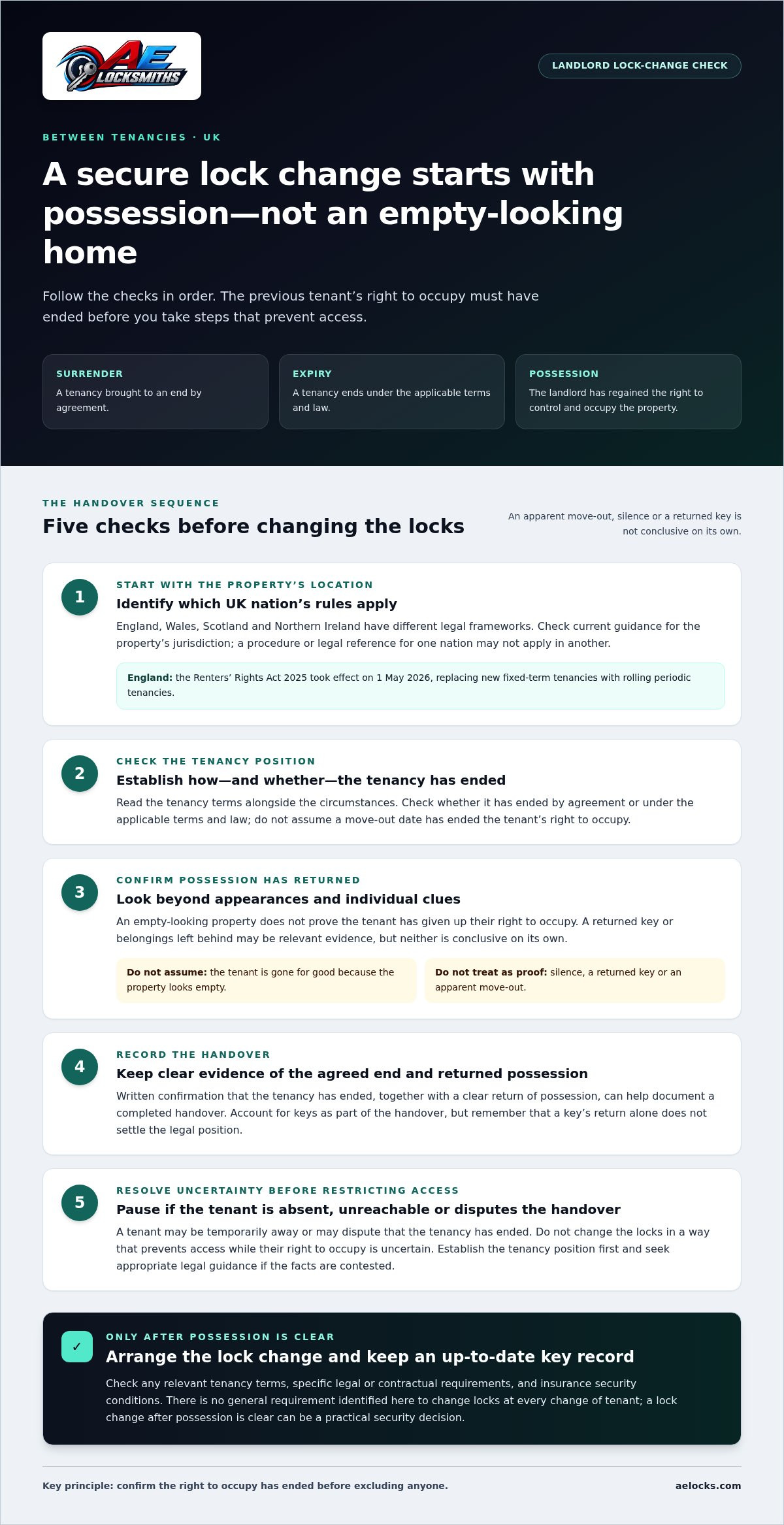
What to check before changing locks at a rental property
A short, documented check helps prevent a routine changeover from becoming an access dispute. For landlord changing locks between tenants UK law, confirm the tenancy position first, then organise the handover and practical work. Follow these steps in order. If possession is disputed, pause and seek legal guidance for the property’s jurisdiction before restricting access.
- Verify the tenancy status. Check the relevant agreement, written notices and communications, and any record of an agreed end date or surrender. Establish that the tenancy has ended and possession has returned under the law that applies to the property. A vacant-looking home, unpaid rent or a tenant who can’t be reached isn’t enough on its own. Treat a genuine emergency separately from planned turnover: urgency may affect the practical response, but it doesn’t remove legal duties or resolve an unclear right to occupy.
- Document the handover. Note the date and time possession was returned, who attended, what was agreed and which keys were handed back. Keep relevant messages and record the property’s condition, including the existing lock’s condition and any visible damage. If the tenant disputes the handover or says they still have a right to occupy, don’t proceed as though it’s routine. Keep tenancy records and personal data secure, and share them only with people authorised to handle the matter.
- Account for keys and access devices. List keys, fobs and other access devices returned, along with any known copies held by authorised people. Record anything missing or unaccounted for rather than assuming every copy has been returned. After a change, note which new keys or devices are issued, to whom and when. Keep the access record limited to the details needed to manage the property, and protect it from unauthorised access.
- Plan the work and handover. Check whether the tenancy agreement, property management arrangements or insurance policy sets any relevant security or lock requirements. These are items to review, not universal rules that apply to every tenancy or property. If replacement is appropriate, plan the work for after possession and access rights are clear. Make sure the next authorised occupant receives working keys and understands the agreed access arrangements.
Confirm status and record the handover
Good records make it easier to show why the change was arranged and what happened to the old keys. Keep the handover notes factual, dated and stored securely. Record the new lock’s condition after the work and update the access list. A note that keys were returned is useful, but it doesn’t replace establishing that the tenancy has legally ended.
Plan keys and access for the next occupant
Decide who is authorised to hold keys and how the handover will be recorded before issuing them. Avoid informal copying or sharing that leaves the landlord unsure who can enter. Any access plan must respect the occupants’ privacy and legal rights. Once possession is clear, AE Locksmiths can help with residential lock replacement in Liverpool and Merseyside. Arrange a residential lock change as part of a properly recorded property handover.
After possession is clear, arrange a secure lock change
Once possession and the right to change the locks are clear, a locksmith can handle the physical work, including lock replacement or other security hardware work. The aim is a secure, usable property and a straightforward handover, not simply a new lock. Many landlords coordinate lock updates alongside wider property turnover tasks, such as booking Apartment Clean to ensure the home is thoroughly cleaned before new residents arrive. Plan for authorised occupants to receive working keys, and update the access record to show who has them.
Consider how the property will be used next and what security requirements apply. Check the existing lock’s condition, account for the keys returned and review any relevant tenancy or insurance requirements. The practical choice should follow the property’s needs, not an assumption that the same work suits every rental home.
Lock replacement and rekeying serve different needs
Replacing a lock means removing the existing lock and fitting a different one. Rekeying changes the lock’s keying so that a different key operates it, without necessarily replacing the whole lock. Which approach is appropriate depends on the lock’s condition, the level of control needed over old keys and the landlord’s security requirements. A locksmith can assess the existing hardware before recommending work. Don’t assume either option will suit every door or situation.
For example, if the existing lock is damaged, changing how it works may not address the condition of the hardware. If the concern is that previous keys may still be in circulation, the appropriate option depends on the lock and the access plan. Decide how keys will be controlled and recorded after the change.
A local locksmith can handle the physical security work
AE Locksmiths is a family-run Liverpool locksmith serving Liverpool, Warrington, the Wirral, St Helens, Widnes, Chester, Northwich and surrounding areas. Its residential locksmith service includes lock replacement and security hardware installation. AE Locksmiths provides a 20-minute response-time guarantee and a 12-month guarantee on parts. These are service details, not legal advice. Confirm that the legal right to change the locks is clear before arranging the work.
After the change, test the new keys and make sure each authorised occupant receives the access they need. Record how many keys were issued, who received them and when. Keep the access record secure, and update it if keys are later returned or reissued. A tidy handover helps reduce uncertainty for both the landlord and incoming occupants.
When planning a lock change, focus on the physical work needed, the condition of the existing hardware and how access will be managed after the handover. Tenancy or possession questions should be resolved separately through appropriate legal guidance.
Once your right to proceed is clear, arrange residential lock replacement with AE Locksmiths for your Liverpool or Merseyside property.
Make the next handover secure and well organised
Before the next occupant moves in, make the security handover part of your property’s preparation. Keep a clear record of who holds each key, make sure authorised occupants can access the home, and store access details securely. If the tenancy position is uncertain, resolve that separately before arranging work that could restrict someone’s access.
The practical side of landlord changing locks between tenants UK law starts with being sure you’re entitled to proceed. Once that’s clear, a locksmith can handle the physical lock change, while tenancy or possession questions should be addressed through appropriate legal guidance. A well-managed changeover gives incoming occupants a clear start and helps you keep control of property access.
AE Locksmiths is a family-run Liverpool locksmith serving Merseyside and surrounding areas. There are no call-out fees or VAT. If your property is ready for a lock change, arrange a professional lock change with AE Locksmiths. Take the next step with a secure, properly recorded handover.
Frequently Asked Questions
Can a landlord change the locks if a tenant has rent arrears?
No. Rent arrears alone don’t allow a landlord to lock a tenant out or use a lock change to recover a debt. Before treating the home as vacant, establish that the tenancy has ended and possession has lawfully returned. The rules differ between England, Wales, Scotland and Northern Ireland, so check current guidance for the property’s location. If the tenant may still occupy it, handle the arrears separately through the proper legal route.
Does a landlord have to give the new tenant every key to the property?
There’s no universal number of keys to provide without checking the tenancy terms, property arrangements and applicable law. The new tenant should receive the keys and access devices agreed for the tenancy, and enough access to use the home securely. For example, record how many door keys and fobs are handed over, who receives them, and any agreed arrangements for shared entrances. Keep the handover record up to date.
Can a landlord keep a spare key after changing the locks?
A landlord may hold a spare, but having a key doesn’t give unrestricted permission to enter an occupied home. Any entry must respect the tenant’s rights, the tenancy terms and applicable law. Agree practical access arrangements with the occupant, including how emergencies will be handled, and check the requirements for the property’s jurisdiction. Store any spare securely and limit access to people authorised to hold it.
What should a landlord do if a tenant leaves without returning the keys?
Document attempts to contact the tenant, the property’s condition and exactly which keys were returned. Missing keys alone don’t prove that the tenancy has ended or possession has returned, so don’t assume the home is vacant. Once the legal position is clear, consider whether old keys may still be in circulation and what security work is appropriate. If occupancy is disputed, seek guidance for the property’s jurisdiction before restricting access.
Can a tenant claim the cost of changing a lock from their landlord?
Possibly, but reimbursement isn’t automatic in every case. Responsibility may depend on why the lock needed changing, what the tenancy agreement says, the property’s condition and the circumstances. For example, a lock that fails through wear may raise different questions from one damaged by a tenant. Keep receipts, photographs and written communications. If you disagree about who should pay, check the tenancy terms and relevant local legal guidance.
Do landlords need to tell a former tenant that the locks have been changed?
That depends on whether the tenancy has genuinely ended, how the handover took place and the rules for the property’s jurisdiction. Where appropriate, written communication can clarify the tenancy end date, keys returned and any agreed access arrangements. But telling someone about a lock change doesn’t make it lawful if they still have a right to occupy. Check current local guidance before relying on a notice requirement or exception.


