

What if the right entry system depends less on the technology and more on how people use each door? If you’re researching electronic access control Liverpool businesses can use, start with who needs access, where they need to go and when. A staff entrance, a stockroom and a shared office may each need a different approach.
It’s understandable to be unsure whether cards, fobs or another method will suit your premises. Lost credentials and changing staff permissions can also make traditional keys harder to manage, especially when access needs to fit alongside your wider security arrangements.
This guide explains common access-control methods, what they can manage and what to consider before planning a system for your Liverpool site. You’ll also learn how entry control can sit alongside CCTV, alarms and locksmith support. AE Locksmiths is a family-run Liverpool business offering commercial fob and card entry, alongside other security services. We serve businesses across Liverpool, Warrington, the Wirral, St Helens, Widnes, Chester and Northwich.
Key Takeaways
- See how credentials and permissions work together to grant or refuse access at different doors.
- Compare fobs, cards and PIN keypads to weigh user familiarity against the work of managing credentials.
- Use a simple planning sequence to map entry points, visitor needs, staff-only areas and daily routines.
- Learn what to consider when fitting electronic access control Liverpool businesses can manage as staff and responsibilities change.
- Understand what details about your doors, users and routines can help shape a practical discussion with AE Locksmiths.
What electronic access control means for Liverpool businesses
Electronic access control manages authorised entry using credentials and permissions. A credential identifies a user or provides a way to request entry; permissions determine which doors they may use and, where configured, at what times. For a business, it means deciding who can enter specific areas and under what conditions.
This can help in Liverpool offices, workplaces and shared commercial buildings where access needs differ between a public entrance and staff-only areas. The aim isn’t necessarily to control every door. Choose the doors where clearer entry rules would help, and keep those rules practical for the people using the premises.
With a conventional key, access is managed by issuing and collecting keys. If one goes missing or isn’t returned when someone leaves, the business may need to consider changing or rekeying a lock. Electronic systems can instead link access to credentials and permissions. Depending on the system, a lost fob or card can be disabled without changing every user’s access. The What is Access Control? overview provides wider context on the principle behind these arrangements.
How electronic access control works at an entry point
At a controlled door, a reader checks a presented credential against the access permissions set for that user. If the credential is valid for that door and permitted at that time, the system allows entry. Otherwise, the request is declined. A fob or card is the credential, not the permission itself, so different people can have different access rules.
Which Liverpool premises might consider controlled entry?
An office might control its main entrance or restrict access to a staff-only room. In a shared commercial building, one organisation may need access to its own workspace while visitors use a common entrance. A workplace could set different rules for a general staff area and a room holding equipment or records. Not every site needs a complex, multi-door system.
Start with the doors and routines that matter, rather than choosing devices first. Consider:
- Which entrances are used by staff, visitors or both?
- Are there rooms that only particular people should enter?
- Do access needs change during the working day?
- Who will issue credentials and update permissions when roles change?
A single door with a clear access need may call for a simpler arrangement than premises with several user groups and restricted areas. Suitability depends on the doors, the people using them, daily routines and the level of control required. Mapping these points gives you a practical starting place for discussing electronic access control Liverpool businesses can use without adding unnecessary complexity.
How credentials and permissions work in an electronic access-control system
At a controlled door, a person presents a credential to a reader or enters a code on a keypad. The system checks it against the permissions assigned to that user and entry point. If the access rules allow entry, the system grants it; otherwise, the request is refused. The exact process depends on the equipment and its configuration.
Keep the two parts distinct. A fob or card identifies a user or provides a way to request entry; permissions set out what that credential can access. Someone might be authorised to enter the main workplace but not a restricted room. Access can also be limited to certain times, so the rules reflect people’s roles and working patterns.
Fobs, cards and PIN keypads: common ways to gain entry
Fobs and cards are physical credentials presented at a reader. A fob can be carried on a keyring, while a card can sit with other workplace passes. With a PIN keypad, the user enters a code instead. Each method has practical considerations around how people gain entry and how credentials or codes are administered. For a closer comparison, see this fob and card access-control guide.
Permissions, lost credentials and access records
Set permissions to match real responsibilities. For example, a team member may need access to their usual work area, while a manager may also need entry to another room. Review these rules when roles change, and when a fob or card is lost or not returned when someone leaves.
Act promptly if a credential is lost: identify it and review which doors and times it can access. Depending on the system, an administrator may be able to change or remove its permissions. This differs from simply collecting a physical key, and the steps available depend on the equipment and configuration.
Some systems can keep records of access attempts or entries. Capabilities vary, so understand what the system captures and who is responsible for reviewing it before relying on records for day-to-day oversight.
A simple administration routine can prevent permissions from drifting out of date:
- Assign each credential to the person who uses it.
- Record which doors and times each user needs.
- Review access after role changes, lost credentials or staff departures.
- Make clear who is responsible for updating permissions.
These details help shape electronic access control Liverpool businesses can manage as people and responsibilities change. AE Locksmiths provides commercial fob and card entry for businesses.
Choosing an access-control approach for a Liverpool business
The useful question isn’t which method has the most features. It’s which one fits the people using your premises and the doors that need control. Consider how familiar the method will be to staff and visitors, what happens if a credential is lost or shared, and who will keep access up to date. An arrangement that meets the need without unnecessary complexity is often easier to manage.
Use this comparison to narrow down the options. Exact capabilities depend on the system selected and your project requirements.
| Approach | User familiarity | Credential handling | Where it may fit | Management considerations |
|---|---|---|---|---|
| Fob or card | Usually familiar in workplaces where staff already carry passes or keys. | Issue a credential to each user; have a process for lost or unreturned fobs and cards. | Staff entrances or doors used by regular, identifiable users. | Keep track of who has each credential and review access when roles change. |
| PIN keypad | Simple to use for people who know the code. | Users enter a code rather than carry a physical credential. | Entry points where a code-based method suits the users and routine. | Consider how codes are shared and how they’ll be changed if access needs shift. |
| More controlled credentials | May require a different routine or additional user guidance. | Can be considered where the business needs more individualised access arrangements. | Doors serving areas with narrower access requirements. | Weigh the level of control needed against the effort of administering it. |
Match the entry method to users and doors
Start with the people and routines. Frequent staff turnover may make individual credentials easier to administer than a code shared across a team. Regular visitors may need a different process from employees. Then map the entry points: everyday staff access may be straightforward, while a room for equipment, records or other sensitive materials may need tighter permissions.
Don’t treat biometric access, such as fingerprint recognition, as the automatic next step for a sensitive area. The right approach depends on who needs entry, how the door is used and the level of control genuinely required. Match the method to the situation rather than adding complexity by default.
Consider records, privacy and connected security
Some systems can record access activity. If those records identify people and when they entered, they may involve personal data. Consider how records are accessed, used and retained, and consult UK GDPR information from the Information Commissioner’s Office (ICO) as part of your data-protection planning. This is general guidance, not legal advice.
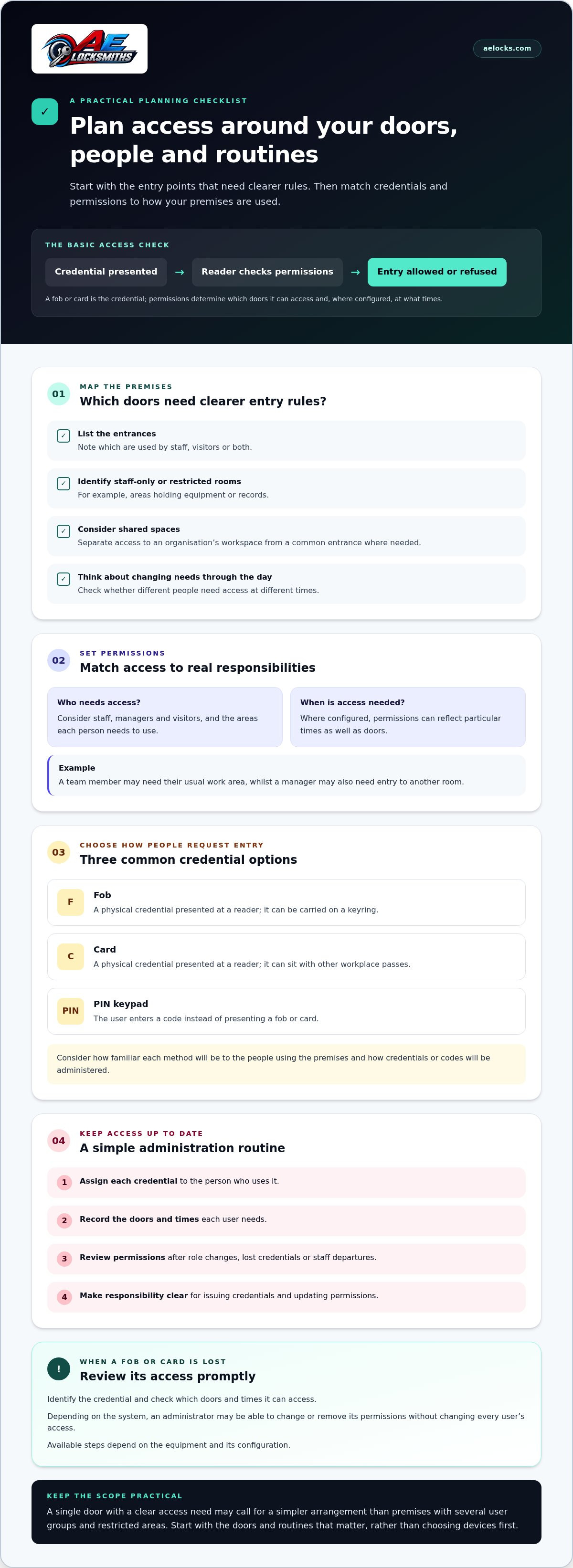
Plan access control around your Liverpool premises and daily routines
A practical plan starts with how people move through your site, not a shopping list of equipment. Before choosing an entry method, map the doors that matter, who uses them and what needs to happen during a normal working day. This keeps the arrangement focused on real access needs, whether you’re responsible for one workplace or a shared commercial building.
Map entry points, users and access needs
Walk the premises and note each entrance or internal door where controlled entry could solve a clear problem. Include staff-only zones, restricted rooms and shared areas where visitors or contractors pass through. Then group users by their role and access needs, rather than assuming everyone should have the same permissions.
- List the doors and areas. Note which doors are used by staff, visitors, contractors or more than one group. Mark areas where access needs to be limited.
- Describe user groups. Consider what regular staff, managers, cleaners or contractors need to reach. Base the groups on tasks, not job titles alone.
- Map the daily routine. Record usual opening and closing patterns, busy entry periods and times when access needs differ. Include visitor arrangements and how out-of-hours entry is handled.
- Identify management tasks. Decide who will issue credentials, update permissions when responsibilities change and act when a credential is lost or not returned.
This sequence may show that only one entrance needs controlled access, or that different doors serve distinct user groups. Don’t assume a complex multi-door arrangement is necessary. Aim for the simplest suitable plan that covers the needs you’ve identified.
Prepare for a site-specific discussion
Existing doors, locks and the site layout shape how access control can be planned. Door construction, the routes people take and the relationship between shared and staff-only spaces all affect the work involved, so there isn’t one standard setup for every premises. For facilities that also require reinforced security doors or automated perimeter access, specialists like Apex Gateworks Inc. show how custom gate and door fabrication can be paired with automated entry hardware.
Before discussing the project, gather a few useful details:
- Which doors already have locks or other entry arrangements?
- How do staff and visitors currently enter, and where do they go afterwards?
- Are CCTV cameras or alarms already part of the premises’ security arrangements?
- Who will be responsible for keeping access permissions current?
This gives a clearer picture of how entry control may fit alongside existing measures. The commercial locksmith guide for Liverpool businesses covers related premises-security considerations. Bring your door list, user groups and daily routines together before planning electronic access control around your actual site.
For business entry needs, AE Locksmiths provides commercial fob and card entry.
Discuss electronic access control with AE Locksmiths in Liverpool
You don’t need to arrive with a system specification. A useful first conversation starts with how your premises work: which doors people use, which areas need controlled access and where your current arrangements cause difficulty. Explain what staff, visitors and contractors need to do during a normal day, including any differences in opening routines or out-of-hours access.
What to cover when discussing your business requirements
Bring a clear picture of the site and the people who use it. Note existing locks, the entry points you’re considering and any staff-only areas. Describe how visitors are received, how contractors move around the premises and who should have access to particular spaces. Mention who will manage credentials and permissions as staff roles change. This keeps the discussion focused on your needs, not assumed equipment.
- Doors and areas: Identify the entrances and internal spaces where controlled access could be useful.
- User groups: Describe staff roles and the access each group needs, rather than treating every user alike.
- Daily routines: Explain opening and closing patterns, visitor movement and any out-of-hours requirements.
- Management: Decide who will administer credentials and respond to lost, unreturned or reassigned access items.
These details make the conversation concrete. A main entrance used by staff and visitors may raise different questions from a door serving an area reserved for particular employees. Note where the existing entry routine works well, too, so any proposed changes remain practical for the people on site.
A local route from access questions to a practical plan
Planning electronic access control Liverpool businesses can use begins with understanding their premises and routines. AE Locksmiths is a family-run Liverpool company offering commercial fob and card entry. The discussion can focus on how these credentials fit your doors, user groups and approach to managing access, without assuming every site needs the same arrangement.
If CCTV or alarms already form part of your security, mention them where they relate to the entry requirements. They may complement access control as part of wider premises security, but they’re separate considerations, not automatic features of an entry system. Clear priorities help keep the plan focused on the security tasks your business needs to address.
Bring your door list, user groups, daily routines and management responsibilities together. That gives AE Locksmiths a useful starting point for discussing commercial fob and card entry for your Liverpool premises.
Discuss business access control with AE Locksmiths.
Keep your entry plan useful as your business changes
Access arrangements shouldn’t be left untouched as your premises and working patterns evolve. A room may take on a new purpose, teams may change, or visitor routines may shift. Review whether your access rules still match how the site is used and whether someone is clearly responsible for keeping them current.
That ongoing attention matters as much as choosing an entry method. It helps prevent a workable plan from becoming confusing or out of step with everyday operations. Keep reviews practical: check whether access still supports how people need to move through the premises, and note any changes that call for a fresh discussion.
If you’re considering electronic access control Liverpool, use your site’s real requirements as the starting point rather than assuming a particular technology is right. A straightforward conversation can help turn access questions into a practical next step for your business.
Discuss business access control with AE Locksmiths and take the next step with confidence.
Frequently Asked Questions
Can electronic access control work during a power cut?
It depends on the system’s power arrangements and how the door is set to behave if power fails. Some installations may include backup power, but this shouldn’t be assumed. Understand the expected behaviour during an outage, including how authorised entry and safe exit are maintained. This is particularly important if a door is part of an escape route or needs to remain accessible during an emergency.
Can staff use a mobile phone instead of a fob or access card?
They can only use a phone if the chosen access system supports mobile credentials. Compatibility depends on the reader and system configuration, so a phone won’t automatically work in place of an existing fob or card. Consider practical issues too: staff need a suitable phone, and you’ll need a plan for lost devices or people who don’t use a compatible phone. Fobs and cards may be a more straightforward option for some teams.
Does electronic access control replace the locks on a door?
Not always. Some projects use electronic locking hardware, while others may adapt an existing door or lock as part of the installation. The right approach depends on the door, its current hardware and how it needs to operate. A door used as an escape route must also support safe exit. Include the door’s condition and daily use in the assessment before deciding what changes are needed.
Can an access-control system keep a record of who entered?
Some systems can record events associated with credentials, such as which credential was used and when. That record doesn’t necessarily prove who physically passed through the door, for example if someone follows another person in. The information stored varies by equipment and setup. If records identify staff or visitors, treat them as personal data: decide who can view them and consult Information Commissioner’s Office guidance on UK GDPR.
Can access control be used on a fire exit?
It may be possible to control access at a door on an escape route, but the system must not prevent people from leaving safely. The design needs to account for what happens during an emergency, including release when the fire alarm activates where required. BS 7273-4 covers how access-controlled doors on escape routes integrate with fire alarm systems. The door’s role and the building layout matter, so plan this carefully.
What happens when an employee leaves and has a fob or card?
Remove or change the former employee’s access permissions promptly, and ask for the fob or card to be returned. If it’s missing, tell the person responsible for managing the system so they can review the credential’s access. Also check whether the employee knew any shared entry codes, and update those if needed. Include these steps in your staff-leaving process so access doesn’t remain active by oversight.
Is electronic access control suitable for a small Liverpool business?
It can be. A small business might only need to manage access at one entrance or keep a particular room restricted. Start with the problem you want to solve and the time available to manage credentials, not the size of the system. For a business considering electronic access control in Liverpool, a simple arrangement may be more practical than adding features the premises won’t use.


