

Imagine it's a Tuesday evening, it's pouring with rain, and you're standing on your doorstep jiggling a key that refuses to turn. Most homeowners have felt that slight catch in the handle or used a key that needs a specific "knack" to work, yet we often ignore these minor frustrations because life is busy. You likely know that something is wrong, but the anxiety over high emergency call-out fees or the confusion of a complex uPVC system makes it easy to procrastinate.
Recognising the signs of failing door lock mechanism early is the only way to avoid a stressful and expensive emergency. A broken lock is rarely a sudden event; usually, the hardware is trying to tell you something is wrong long before it finally fails. In this guide, we provide a clear checklist to help you diagnose the problem and decide if it's time to repair or replace your hardware. You'll also learn how to find a dependable, family-run locksmith who offers a VAT-free service, ensuring your home stays safe without the sting of corporate pricing.
Key Takeaways
- Learn to spot "floppy handle" syndrome and understand what it indicates about the health of your internal springs.
- Identify the specific grinding noises and visual cues, such as metal shavings, that signal an imminent mechanical failure.
- Understand why resistance in uPVC multipoint systems is a critical warning that requires professional attention before a lockout occurs.
- Master the signs of failing door lock mechanism to distinguish between a simple cylinder fix and a complex gearbox replacement.
- Discover how early diagnosis helps you avoid high emergency fees and take advantage of VAT-free local locksmith services.
What is a Door Lock Mechanism and Why Does it Fail?
When most people think of a lock, they picture the small hole where the key is inserted. In reality, that is just the cylinder. The actual door lock mechanism is the complex "engine" hidden deep inside the door itself. Whilst the cylinder identifies the correct key, the internal mechanism does the heavy lifting of moving the bolts, hooks, and rollers into place. Understanding the basic lock and key mechanism is the first step in diagnosing why your door has become difficult to close. Learning to spot the early signs of failing door lock mechanism can save you from a late-night lockout in the rain.
Modern homes, particularly those across Merseyside, typically rely on uPVC or composite doors. These doors use multipoint locking systems that are far more advanced than a traditional timber door bolt. Because these systems have so many moving parts, they are prone to mechanical wear. The "gearbox" is the central hub of this system. It is the most vulnerable component because it bears the brunt of the force every time you lift the handle. If the gearbox fails, the entire door remains jammed, even if your key turns perfectly in the cylinder.
The Anatomy of a uPVC Multipoint Lock
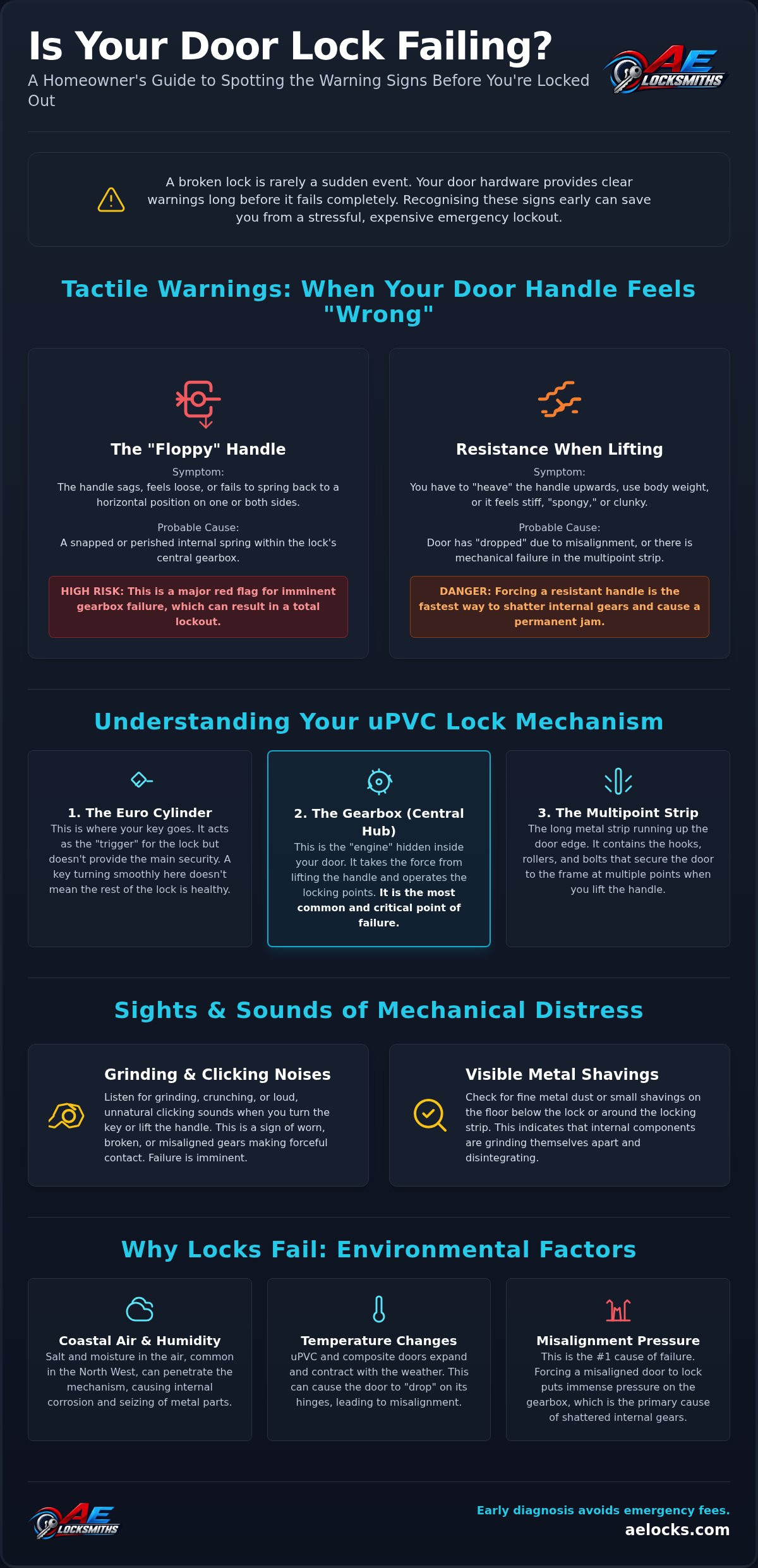
A multipoint lock consists of a long metal strip that runs the full height of the door. When you lift the handle, this strip moves various locking points, such as hooks, rollers, or mushrooms, into the frame. The Euro cylinder acts as the trigger. Once the key is turned, it locks the gearbox in place so the handle cannot be pushed back down. This interaction requires perfect alignment. If any part of this sequence feels stiff or clunky, the internal springs or gears are likely reaching the end of their lifespan.
Why Mechanisms Fail More Often in the North West
Living in the North West presents unique challenges for door hardware. The coastal humidity and salt air common in Liverpool and the surrounding areas can cause internal corrosion. Metal components inside the gearbox can seize up or become brittle over time. Temperature changes also play a significant role. uPVC doors expand and contract with the weather, which often leads to the door "dropping" on its hinges. When a door is misaligned, you have to force the handle upwards to lock it. This extra pressure is the leading cause of shattered internal gears and total mechanism failure.
Tactile Warning Signs: When the Handle Feels "Wrong"
Your door handle is the primary way you interact with the internal hardware. When it starts to feel different, your door is sending you a message. Ignoring these tactile signs of failing door lock mechanism is a common mistake that leads to total failure at the worst possible time. Physical feedback is often the most reliable indicator that something is wrong deep inside the door.
Diagnosing the Floppy Door Handle
A floppy handle that sags or fails to return to the horizontal position is a major red flag. This usually means a spring has snapped. To diagnose this, check if the handle feels loose on both sides of the door. If only one side is drooping, the fault might lie in the handle backplate. However, if both handles are limp, the internal spring within the gearbox has likely perished. This is the leading precursor to a snapped spindle. If the spindle snaps while the door is locked, you'll be unable to open it from either side. For more detail on this specific issue, you can read about uPVC door handle repair Liverpool.
The Resistance Test: Lifting the Handle
Lifting the handle to engage the hooks and rollers should be a smooth, relatively effortless motion. If you find yourself having to "heave" the handle upwards or use your body weight to get it to travel, you have a serious problem. Sometimes this is a simple alignment issue where the door has dropped. In other cases, it is a mechanical failure within the multipoint strip itself.
Forcing a resistant handle is the fastest way to shatter the internal gears. When you apply excessive pressure, the delicate metal teeth inside the gearbox can snap. Once this happens, the mechanism often jams in the locked position. This makes the eventual repair far more complex and expensive. A "spongy" feeling often indicates that the internal levers are no longer making clean contact. If the handle sticks in the down position after you open the door, the return spring is likely failing or the internal lubricant has turned into a thick, gritty paste.
Don't wait for the handle to stop working entirely. If you're struggling with a stiff or unresponsive door, it's worth having a local locksmith in Liverpool take a look before the mechanism fails completely.
Auditory and Visual Signs of Mechanical Distress
Whilst your hands tell you a lot about your lock's health, your eyes and ears provide the final confirmation. A healthy lock should operate in near silence, with only the muffled sound of the bolts sliding into place. If your door begins to sound like a pepper grinder, you are witnessing the internal components physically breaking apart. Recognising these auditory signs of failing door lock mechanism is vital for any homeowner who wants to avoid an expensive emergency call-out.
The "Gearbox Crunch": A Final Warning
The "gearbox crunch" is the sound of metal fatigue. It occurs when the delicate cast-metal gears inside the central casing begin to crumble or lose their teeth. If you hear a sharp clicking or a distinct grinding sound when you lift the handle, the mechanism is on the verge of a catastrophic failure. In our experience, once a lock starts crunching, it often has fewer than 10 successful operations left before it jams for good. This often leads to a "deadlock" state. In this scenario, the internal components have snapped whilst the door is locked, making it impossible to open the door from the inside or the outside without professional intervention.
You should also look for visual evidence of friction. Open your door and inspect the metal strip and the floor beneath it. If you see fine silver dust or small metal shavings, the internal gears are grinding against each other. Another visual red flag is a key that starts spinning without resistance. If you turn the key and it feels like it isn't "catching" anything, the connection between the cylinder and the gearbox has likely snapped.
Visible Misalignment and Strike Plate Wear
Merseyside's coastal weather is particularly harsh on uPVC doors. The high humidity levels and salt air cause frames to expand and contract more aggressively than in inland areas. This constant movement often causes the door to "drop" on its hinges. You can spot this by looking at the metal keeps, also known as strike plates, on the door frame. If you see deep scuff marks or "shiny" patches on the metal, the bolts are no longer sitting flush. They are hitting the frame instead of sliding into the holes. This misalignment puts immense pressure on the gearbox, accelerating the wear on the entire system. A quick visual check for a warped door leaf is also helpful; simply look down the edge of the door to see if it remains perfectly straight or has begun to bow in the centre.
Key Related Issues: Is it the Key or the Lock?
It's often difficult for a homeowner to tell if they are dealing with a faulty key or a deeper mechanical failure. Whilst a bent or worn key can cause issues, the way the lock responds to that key provides the most clues. If you've developed a "knack" for opening your door, such as jiggling the key or finding a specific "sweet spot", you are witnessing the early signs of failing door lock mechanism. This behaviour suggests that the internal pins or the connection to the gearbox are no longer aligned correctly.
Difficulty inserting or removing the key is another red flag. This often happens when the internal springs within the cylinder have lost their tension. Over time, debris and metal dust can also build up inside the barrel. If you have to fight to get your key back out after unlocking the door, the mechanism is under significant stress. Ignoring this usually leads to a snapped key, which adds the cost of extraction to your repair bill.
Euro Cylinder Failure vs. Mechanism Failure
To diagnose the issue, perform a simple test with the door open. If the key turns smoothly and the bolts extend whilst the door is not in the frame, your problem is likely door alignment rather than a broken part. However, if the key is difficult to turn even when the door is open, the Euro cylinder or the gearbox is failing. A faulty cam inside the cylinder can often mimic a broken gearbox. If the cam is worn, it may fail to engage the internal levers of the mechanism, leaving you unable to secure your home even if the key feels like it is turning.
When the Key Spins Freely
A particularly alarming symptom is when the key spins 360 degrees in the lock without any resistance. This usually indicates that the "cam", the rotating part in the centre of the cylinder, has snapped or detached. This is a common occurrence on high-traffic front doors in Merseyside, where constant use eventually fatigues the metal. When this happens, the key can no longer retract the deadbolt or move the multipoint hooks. You might find yourself trapped inside or locked out despite having a working key in your hand.
Trying to force a stuck key or continuing to use a spinning lock will only lead to a more expensive repair. If your key is behaving strangely, it is best to contact a residential locksmith to identify the fault before you are left with a snapped key or a jammed door.
Professional Solutions for Homeowners in Merseyside
Once you've identified the signs of failing door lock mechanism, the next step is choosing how to fix it. Many homeowners are tempted to try a DIY repair after watching a video online. However, uPVC multipoint systems are precision-engineered pieces of hardware. Attempting to dismantle the gearbox or realign the locking strip without the correct tools often results in the system jamming permanently. This usually turns a straightforward repair into a costly emergency lockout that requires destructive entry to resolve.
Choosing a local specialist like AE Locksmiths ensures the job is done right the first time. As a family-run business in Liverpool, we prioritise honest advice over quick sales. One of the biggest advantages for our residential customers is our "No VAT" pricing. National franchises often add a 20% tax to the final bill, but because we are an independent local firm, we pass those savings directly to you. We also don't charge call-out fees. This means you only pay for the expertise and parts required to secure your home.
Repairing vs. Replacing the Full Mechanism
In many cases, you don't need to replace the entire metal strip that runs down the side of your door. If the failure is confined to the central hub, a simple gearbox swap is often possible. This is a faster and more affordable solution that utilises your existing hardware. However, if the mechanism is an older, obsolete model or shows signs of heavy corrosion, a full multipoint replacement is the better long-term investment. For a detailed look at this process, see our guide on broken uPVC door mechanism Liverpool.
Securing Your Home in Liverpool and Beyond
We provide a comprehensive range of services, including residential locksmithing and uPVC door repairs. Our team covers the entire Merseyside region, including St Helens and the Wirral. We understand that lock issues are stressful, which is why we maintain a 20-minute rapid response time for local calls. Every part we fit comes with a 12-month guarantee, giving you peace of mind that your home is secure. If your door is showing signs of distress, don't wait for it to fail completely. Contact AE Locksmiths today for a free, no-obligation quote and let a local expert restore your home's security.
Secure Your Property Before the Lock Fails
A failing lock is rarely a sudden crisis. It is a gradual process that gives you plenty of warning if you know where to look. By paying attention to the signs of failing door lock mechanism, such as grinding noises, sagging handles, or keys that require a "knack" to turn, you can fix the problem before it becomes an emergency. Addressing these issues early prevents the stress of being locked out in the rain and avoids the higher costs of destructive entry.
Your home security should be simple and transparent. AE Locksmiths offers a dependable, family-run service across Merseyside with a 20-minute local response and no call-out fees. Every repair is backed by a 12-month guarantee on parts. Because we are an independent firm, we don't charge VAT, which means you get expert service without the corporate price tag.
Don't wait for your door to jam for the final time. Get a VAT-free lock repair quote from AE Locksmiths today and ensure your home remains safe and accessible. We are ready to help with professional, local expertise you can trust.
Frequently Asked Questions
How can I tell if my uPVC door lock is failing?
Look for difficulty when turning the key or a handle that feels unusually heavy. These are common signs of failing door lock mechanism hardware. You might hear a crunching sound inside the door or notice the key won't turn smoothly anymore. Visual cues include metal shavings near the bolts or a door that has dropped on its hinges. If you have to force the door to lock it, the internal gearbox is likely nearing total failure.
Why is my door handle floppy and hard to lift?
A floppy handle usually indicates that the internal return spring within the gearbox has snapped or lost its tension. When the handle becomes hard to lift, the multipoint locking points are likely misaligned with the keeps in the frame. This resistance forces you to put extra pressure on the central mechanism, which eventually leads to a shattered gearbox. It is a clear signal that your door needs professional realignment or a mechanism replacement before it jams.
Can I fix a stiff door lock with WD-40?
Avoid using standard WD-40 as it is a degreaser that can attract dust and grit, eventually gumming up the internal components. For a stiff lock, a dedicated PTFE-based lubricant or graphite powder is much safer. However, if the stiffness is caused by mechanical wear or a dropped door, lubrication is only a temporary fix. It won't repair a failing gearbox or realign the hooks, so a professional inspection in Liverpool is still recommended.
How much does it cost to replace a uPVC door mechanism?
Costs vary depending on whether you need a central gearbox swap or a full multipoint strip replacement. Industry data from 2026 suggests a standard uPVC gearbox replacement averages around £90, whilst a full mechanism can be higher. Prices depend on the specific brand and security rating of the hardware. For residents in Merseyside, choosing a local firm like AE Locksmiths ensures you avoid paying extra for VAT or call-out fees, keeping the repair affordable.
Is it better to repair or replace a failing door lock?
This depends on the age and condition of your hardware. If the central gearbox is the only faulty part and the rest of the multipoint strip is in good condition, a repair via a gearbox swap is often the most cost-effective choice. However, if the mechanism is an obsolete model or shows signs of heavy corrosion from salt air in areas like the Wirral, a full replacement offers better long-term reliability and a fresh 12-month guarantee.
How long does a door lock mechanism typically last?
A high-quality uPVC door mechanism typically lasts between 10 to 12 years. However, this lifespan can be significantly shortened by poor installation or environmental factors. In Merseyside, the humid coastal air can lead to faster internal corrosion. Regular maintenance, such as checking door alignment and lubricating the moving points annually, helps extend the life of the hardware. Once you notice the signs of failing door lock mechanism, it is usually nearing the end of its life.
What should I do if my key is stuck in the door?
Stop trying to force the key immediately. Applying excessive pressure can snap the key inside the cylinder or shatter the internal gears of the gearbox, making the situation much worse. This often happens when the cylinder cam has slipped or the mechanism has jammed. Contact a local locksmith who can use specialist tools to retract the bolt and remove the key safely. AE Locksmiths provides a 20-minute response time across Liverpool to resolve these crises quickly.
Do I need a new door if the lock mechanism fails?
No, you rarely need a completely new door just because the lock has failed. Almost all uPVC and composite door mechanisms are replaceable, even if the original model is obsolete. A specialist locksmith can source a compatible modern version that fits your existing door perfectly. Replacing the mechanism is a fraction of the cost of a new door installation and restores your home's security to a professional standard without the expense of a full replacement.


